Useful author tips that I’ve collected
There’s a lot of writing advice online. Countless YouTube videos provide book writing information, both good and bad. Of course, what I find good information may be of little use to you, and vice versa. However, here are the tips that helped me write.
Firstly, write.
I know it sounds obvious, but there are many people who talk about writing their novel, and most never get around to it. So, sit down in front of that computer, typewriter or pen and paper and just get going. Don’t worry about planning, editing or even punctuation at first. Just write the story. See what happens.
Think about words
Words are really all an author has. Consider how you use them and try to avoid repetition. Words such as “Had,” “Just,” and “Very,” are used extensively when we speak to each other in everyday life, and although you may wish to reflect this in your character’s dialogue, strive to avoid their repetitive use in the narrative.
Sentence structure
Vary your sentence length and timbre. Maybe start with a couple of short sentences, then a long one, then back to a short. Vary this up. When the action in your novel is fast, use shorter sentences. Languid-paced parts suit longer passages. Avoid starting sentences the same way. To get a better idea of this, go to YouTube and type in ISPACE sentences or ISPACED sentences. There are a few good videos on this subject. Your book will read much better with the changes in pace that can be made by sentence length within your paragraph.
Be regular
Try to write on a regular basis. Once you have a good rhythm going, consider writing one day and then editing what you wrote the next. Don’t get too lost in editing at this point, though. Believe me, you will have plenty of time to properly edit after you have finished the book.
If you suffer from writer’s block at any point during the creative process, consider writing the ending next. With the book’s conclusion in place, you may find it easier to then go back and fill in the gaps.
Beta readers
Get as many people as possible to read and comment on your work before you pay for editing. Editing is expensive. Friends and family may be able to catch any errors first. Join a writing club if need be and get feedback from the other members.
Rules
Learn the rules and then be prepared to break every one of them. However, know why you are doing so, as people will certainly point your digressions out to you!
The Novelist’s Toolkit: Balancing Literary Mastery with Compelling Storytelling
Every writer sets out with a simple goal: to tell a story that leaves a reader changed. Yet, between the initial spark of an idea and a finished manuscript lies a vast landscape of technical craft. The tools we choose—our words, structural pacing, and rhetorical devices—can either illuminate a scene or obscure it.
The following guide breaks down the essential mechanics of advanced prose, explores how to fine-tune your sentences, and details how to manage perspective, dialogue, and structure without letting the technical elements get in the way of a brilliant story.
The Rhetorical & Literary Arsenal
Think of literary devices as spices in a kitchen. Used intentionally, they elevate a simple dish into something unforgettable. Used carelessly, they overwhelm the palate. Below is a breakdown of the primary tools available to enhance your prose, along with how to use them effectively.
Imagery and Comparison
| Device | Definition | Example | Best Used For… |
| Metaphor | Directly equating two unrelated things to highlight a shared quality without using “like” or “as.” | “The courtroom was a meat grinder, chewing up the innocent.” | Deepening mood, subtext, and thematic resonance in reflective or descriptive passage |
| Similie | Comparing two distinct things using explicit connectors such as “like” or “as. | “The engine rattled like a box of loose nails.” | Providing quick, vivid sensory anchors during fast-paced scenes or action. |
| Hyperbole | Intentional, stark exaggeration used for emphasis or dramatic/comic effect. | “He had a million secrets hidden behind that blank stare.” | Capturing character voice, building unreliable narration, or emphasizing high-stakes emotional states. |
| Litotes | A deliberate understatement, typically achieved by negating the opposite of what is meant.. | “The news of the sudden military mobilization was not unwelcome.” | Crafting British or academic irony, conveying emotional restraint, or establishing a cool, detached narrative v |
The Power of Repetition and Rhythm
- Anaphora: Repetition of a word or phrase at the beginning of successive sentences or clauses.
- Example: “We shall fight on the beaches, we shall fight on the landing grounds, we shall fight in the fields and in the streets…”
- When to use: Building emotional momentum, driving home a character’s internal obsession, or drafting a high-stakes political or historical speech within your text.
- Symploce: A structural frame where anaphora and epistrophe combine—repeating words both at the very beginning and the very end of successive clauses.
- Example: “Most people want justice, but they cannot find justice. The law promises justice, but it rarely delivers justice.”
- When to use: Emphasizing a structural trap, a deep-seated paradox, or a cyclical crisis from which a protagonist cannot escape.
- Polysyndeton: The deliberate, frequent use of multiple conjunctions (and, but, or) in close succession, often omitting commas.
- Example: “He packed the rifle and the maps and the gold and the passport and left without looking back.”
- When to use: Creating a sense of overwhelming accumulation, exhaustion, or frantic, continuous movement. It elongates the rhythm of a sentence to mimic a heavy cognitive load.
- Asyndeton: The complete omission of conjunctions between coordinate phrases, clauses, or words.
- Example: “He arrived, he looked around, he left.”
- When to use: Speeding up the sentence’s internal clock. It creates a stark, clipped, and urgent rhythm perfect for action sequences or moments of shock.
Contrast and Sound Dynamics
- Antithesis: Placing two starkly contrasting or opposite ideas side by side using a parallel grammatical structure.
- Example: “To err is human; to forgive, divine.” or “The technology promised absolute liberation; it delivered absolute control.”
- When to use: Highlighting underlying thematic conflicts, political divisions, or a character’s deep psychological hypocrisy.
- Oxymoron: A compact figure of speech that pairs two seemingly contradictory terms.
- Example: “A deafening silence filled the briefing room.” or “He smiled with an aggressive kindness.”
- When to use: Signaling psychological tension, immediate environmental shifts, or a moment where a character experiences warring emotions simultaneously.
- Alliteration & Sibilance: Alliteration is the repetition of initial consonant sounds across close words; sibilance is a specific subtype focusing on hissing or sibilant sounds (s, sh, z).
- Example (Alliteration): “The pristine peaks pointed proudly into the sky.”
- Example (Sibilance): “The snake slipped silently through the dry stalks.”
- When to use: Highly descriptive, atmospheric scene-setting. Use it with immense restraint—too much alliteration can inadvertently turn serious literary fiction into children’s verse.
Substitutions and Perspectives
Metonymy: Substituting the name of an object or concept with something closely associated with it, rather than the thing itself.
- Example: “The Crown issued a decree.” (Where “The Crown” stands for the reigning monarch or state authority).
- When to use: Establishing institutional, political, or bureaucratic weight, or grounding a world’s socio-political hierarchy in visual realities.
Synecdoche: A specific form of metonymy where a literal part of something is used to represent the whole (or vice versa).
When to use: Grounding abstract concepts into tactile, industrial, or military realism. It forces the reader to look closely at the physical mechanics of a scene.
Example: “We need more boots on the ground.” (Where “boots” represents soldiers) or “Check out my new wheels.” (Where “wheels” represents the entire car).
Structural Polish: Clearing Out the Clutter
Even a sentence packed with brilliant imagery will falter if it is weighed down by structural inefficiencies. True mastery of prose involves a ruthless editing eye.
Passive Voice vs. Active Voice
In active voice, the subject performs the action (“The detective dropped the file”). In passive voice, the subject receives the action (“The file was dropped by the detective”).
Passive voice often obscures agency and dampens tension. However, it isn’t an error; it’s a tool.
When to use passive voice on purpose: Use it when the perpetrator of an action is intentionally hidden, unknown, or irrelevant to the scene’s focus.
- Active: “An assassin shot the Prime Minister in the courtyard.” (Focuses on the shooter)
- Passive: “The Prime Minister was shot in the courtyard.” (Focuses entirely on the victim and the sudden shock of the event)
Glue Words and Sticky Sentences
Every sentence is composed of two types of words: working words (which carry the essential meaning, like nouns and verbs) and glue words (the grammatical connectors like the, of, to, for, in, was, that, which).
A sentence becomes sticky when the proportion of glue words is too high, causing the reader’s brain to work harder than necessary to extract the actual meaning.
- Sticky Version (Glue Word heavy): “Dominic was in a situation where he was thinking about the way in which the company could manage to save money on its operations.” (24 words — Glue ratio: ~60%)
- Tightened Version: “Dominic scrambled to find ways the company could cut operational costs.” (11 words — Glue ratio: ~30%)
By paring back the structural glue, you let the active verbs take center stage, instantly quickening the story’s pace.
Choosing Your Perspective: First vs. Third Person
The choice of point of view (POV) dictates how close your reader gets to the beating heart of your protagonist.
First Person (I / We)
- The Benefits: Immediate intimacy. The reader sees the world entirely filtered through the protagonist’s biases, traumas, and unique vocabulary. It is the premier format for building a deeply subjective, highly psychological narrative or deploying an unreliable narrator.
- The Trap: It limits your canvas. If your plot involves a multi-front geopolitical conflict or events happening across the globe, a first-person narrator cannot naturally know or show those events unless they are told secondhand.
Third Person (He / She / They)
Third Omniscient: The “god-eye” view. The narrator knows all secrets, histories, and future outcomes. It offers an epic scope, but can feel emotionally distant if not carefully managed.
Third Limited: The camera stays glued to a single character’s shoulder for a scene or chapter. You get the psychological depth of first person, but with the flexibility to jump to other characters’ shoulders in subsequent chapters.
Sharp, Layered Dialogue
Dialogue in a novel should never read like a transcript of a real-world conversation. Real speech is packed with boring pleasantries, accurate repetitions, and meaningless filler. Fictional dialogue is an idealized illusion of speech designed to accomplish three tasks simultaneously: advance the plot, reveal character vulnerabilities, and build subtext.
The Golden Rules of Dialogue
Strong: Jimmy set the coffee mug down, slowly, until the ceramic clicked against the glass table. “I don’t think you have the nerve.”
Exterminate the Mundane: Cut out the “Hello, how are you?” and “I’m fine, thanks.” Start the scene at the exact moment the conversational conflict begins.
Master Subtext: Characters rarely say exactly what they mean. If a husband and wife are on the brink of divorce, they shouldn’t argue about their relationship—they should argue bitterly about who forgot to buy milk. The true conflict lives between the lines.
Weaponize Action Beats: Replace excessive speech tags (“he said angrily,” “she replied nervously”) with physical interactions that anchor the speaker in space.
Weak: “I don’t think you have the nerve,” Jimmy said menacingly.
Form and Scope: Novels vs. Short Stories
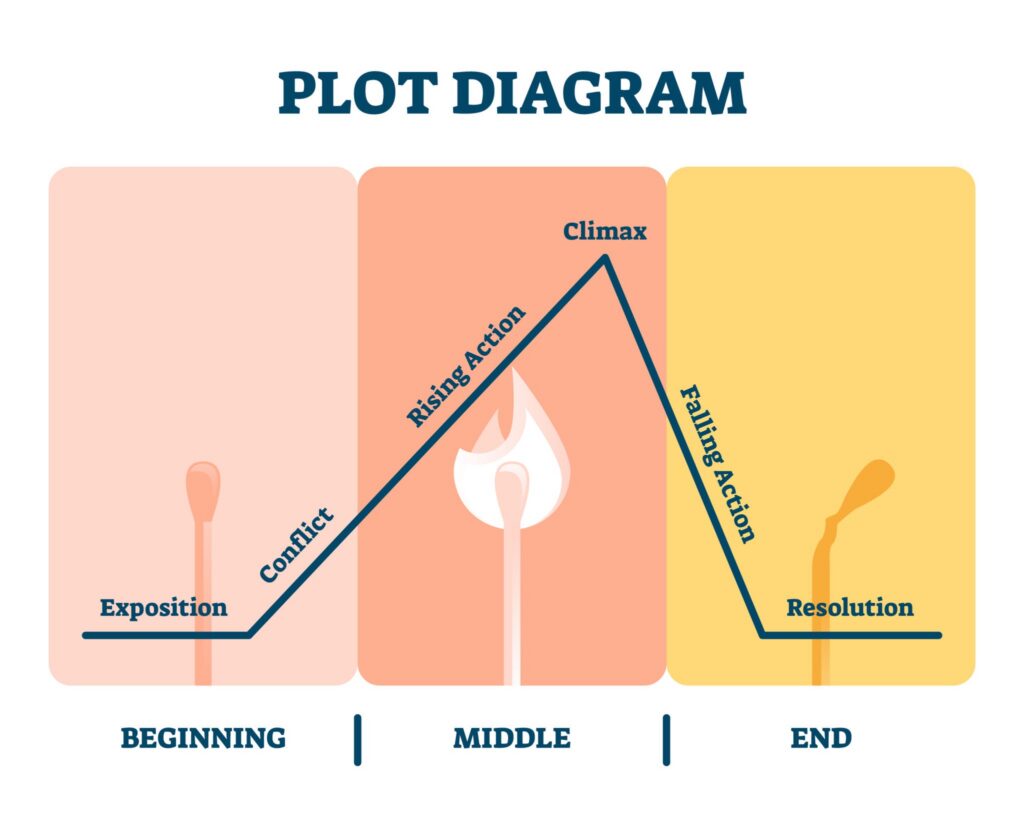
While both formats require excellent prose, a novel is a marathon of architectural design, while a short story is a high-velocity sprint.
The Novel Focus
A novel has the luxury of space. You can build sprawling subplots, chart decades-long character arcs, explore macro-economic or historical settings, and allow your characters to make mistakes that take hundreds of pages to resolve.
The Short Story Rules
In a short story, Edgar Allan Poe’s rule of the “single effect” reigns supreme. Every line, character, and setting must drive toward a singular emotional payoff or realization.
Focus on a Singular Shift: A short story rarely tracks a lifetime of change; it focuses on a single choice, a sudden revelation, or an acute moment of realization that alters a character’s trajectory forever.
Arrive Late, Leave Early: Start the story right before or during the central crisis.
Limit the Cast: Stick to one or two main characters. You don’t have the real estate to establish multiple complex backstories.
The Ultimate Rule: Story Over Structure
Every technical rule, rhetorical framework, and stylistic preference outlined above exists for one reason: to serve the narrative.
If you find yourself writing a sentence just to showcase a perfect example of symploce, or forcing an intricate antithesis into the mouth of a gritty action protagonist where it makes no sense for their voice, stop.
Prose styles should never draw attention to themselves at the expense of immersion. If a rule stops the momentum of a gripping scene, or dampens the emotional truth of a character’s pain, break it without hesitation. Literature is the vehicle; the story is the destination.